
Every dollar, one pool.
USDC, USDT, PYUSD and the next dollar share one pool on Solana. If one breaks, the rest keep trading.
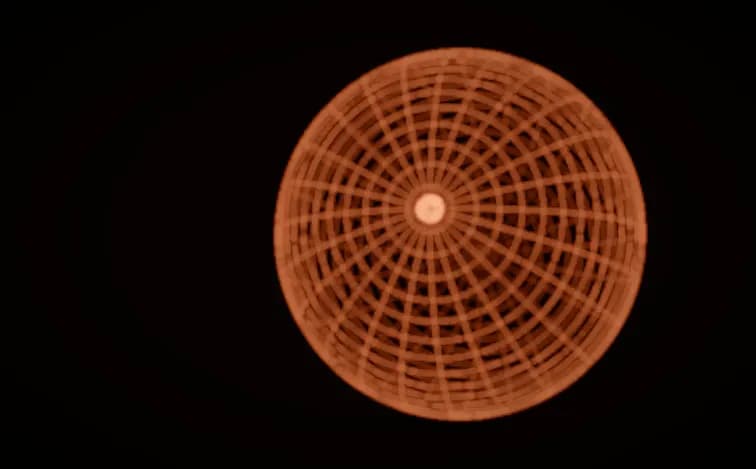
Not a pair. A sphere.
Every coin's reserve is one coordinate of a single point on a sphere.
When all of them are worth $1, the point sits dead centre, facing you. A trade slides it across the surface; the slope under it is the price.
Designed by Paradigm
Orbital, by Dave White, Dan Robinson and Ciamac Moallemi, 2025. They published it and called it just a design. DOME is that design, built to run on Solana.
Read the paperLiquidity lives in caps around $1
A band is a cap: every price inside its rim, nothing outside. You pick the rim when you deposit.
The $0.90 band is 2.8° wide. The $0.99 band, 0.27°.
The $0.999 band is 0.027°. With three coins it needs about 1/1,098 of the capital the whole sphere would.
Five coins, the paper's example: about 15x at $0.90, about 150x at $0.99.
Closer to $11x
Break a coin
Colour is price: cream at $1, burning out as one coin falls. Each band that the falling coin reaches stops at its own rim.
- Bands still taking USDT
- 8 of 8
- USDC to PYUSD
- $1.0000
Every band is in range. Drag the price down.
One coin breaks.
Isolated.
A falling coin only reaches the bands that chose to stand near it, and each of those stops at the price it picked. Every other band keeps quoting $1.
Tested, not promised
Measured on the program and its exact model before launch.
- $998,748
- Paid out by the $0.998 band when USDC was sold down to $0.90. Its limit was $998,749.
- $1.83M vs $2.65M
- What liquidity providers lose in that depeg: $40M in DOME against the same $40M in one Curve-style pool.
- 42 bp
- What today's best Jupiter route loses swapping $1M of USDT to PYUSD. One $40M DOME pool: about 7 bp, fee included.
Swap any listed dollar for any other in one instruction, or deposit and pick how close to $1 you stand.